
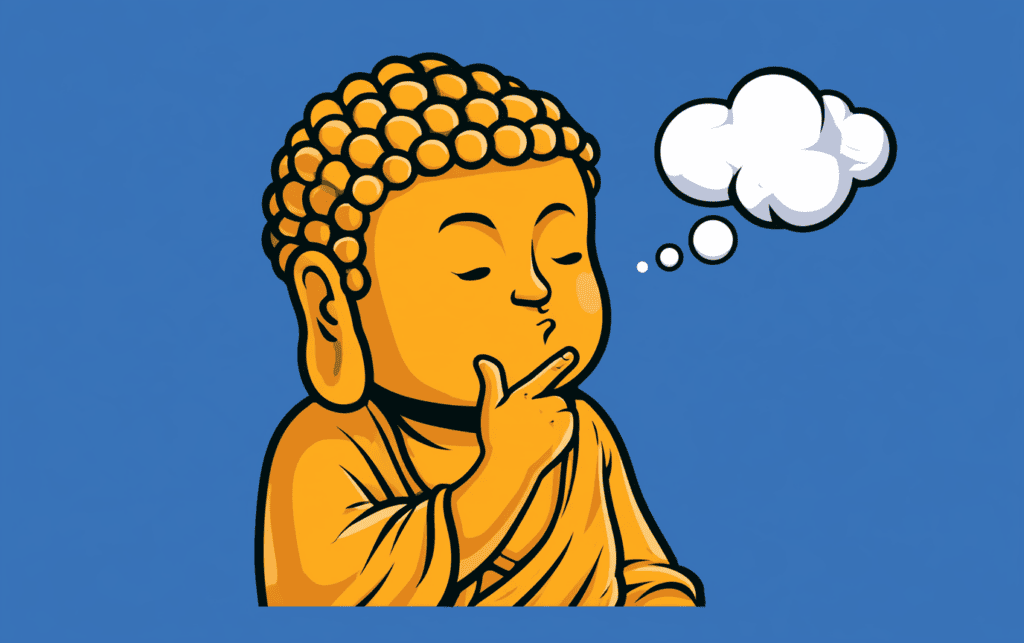
If you’ve spent any time on this site, you likely know that Buddhism holds an influential place in my life. You might also realize that I don’t view Buddhism, as I experience it, as a “religion.” I also tend to avoid using “Buddhist” as a self-descriptor. Because there are so many different branches and interpretations, using the label often leads people to paint me in whatever color of “Buddhist” they are already familiar with. In my experience, the label is more likely to lead to erroneous conclusions than to actually shed light on who I am.
There are times, however, when it would be incredibly convenient to fall back on the phrase, “But I’m a Buddhist.”
Take the topic of non-human animals, for instance. Buddhism places “sentient beings” in a special class, and many of us believe that most—if not all—living things fall into that category. In a debate over animal rights, I could argue the merits of the position, or I could simply say, “But I’m a Buddhist,” and cut straight to the credits.
Most of us are familiar with how religion works in social contracts. We understand that if a Muslim says they can’t eat a certain food, or a Christian says they don’t work on Sundays, it creates a wall. Whether you believe in their faith or not, you recognize that when someone subscribes to a specific set of tenets, the conversation usually stops there. It’s a “no-go” zone.
If I were discussing animal rights and I just wanted the conversation to end, I could play the “But I’m a Buddhist and we believe…” card. It would be my “get out of conversation free” card. But in doing so, I’d be totally giving up on the goal of helping another person understand why I hold my position.
But there is another side to this card.
When a topic comes up and your belief system gives you an easy “out,” what happens to the part of you that is supposed to be rethinking and evolving? If I immediately jump to “But I’m a Buddhist,” I’m not just ending the discussion with the other person—I’m stopping myself from having to think.
Sticking with the animal example: Why do I actually believe my cats are sentient? In a desperate situation where I have to choose who to save, are my cats on equal footing with a human? And what, exactly, does “sentient” even mean?
So, let’s rewind. I’m having a discussion about animal rights. I choose not to take the easy out. I listen to the other person’s perspective, and they listen to mine. In the end, perhaps neither of us budges from our original position. But what we did do was respect the other person enough to actually hear them. Instead of assuming they are wrong—or worse, stupid—we acknowledged that they are a thinking being whose conclusion was reached through a different life experience than our own.
This is how we actually learn. I don’t mean “learning” in the sense of reading a book and memorizing a fact; I mean the kind of learning that fertilizes your grey matter and forges new synaptic connections. This is why diversity of thought is so vital. Do you really want a world of inbred ideas, or would you prefer something that actually forces you to think?
We don’t have to agree on everything—in fact, it’s better that we don’t. But we do have to agree that we are okay sharing space, and rights, with people who think differently. We have to respect the fact that they are sentient beings who arrived at their conclusions through a process and a history different from ours.
Choosing the “easy out”—avoiding the effort of rethinking your own beliefs while wholesale rejecting the beliefs of others—might be convenient. But it is almost always the wrong choice for our personal growth, and it is a detriment to the ultimate benefit of our species… the human animal.